Bees at Mar Vista
Bees were always part of our vision for Mar Vista. From the beginning, as we planted more flowers, vegetables, and fruit trees, it felt only natural to welcome these quiet collaborators into our farm’s ecosystem. Our goal was never just about harvesting honey, but about creating the right habitat for pollinators to truly thrive — with abundant pollen and nectar, fresh water, and a protected home woven into the landscape. The honey has simply become a beautiful and delicious byproduct of that intention, and being able to share it with our guests — honey drawn from the very flowers growing here at Mar Vista — feels especially meaningful. Each season, and each hive, carries its own unique rhythm, deepening our connection to the land and to the bees themselves.


Hives at Mar Vista
From the time we were living in the Bay Area, we had already begun researching beekeeping — that was when the seed was first planted. By the time we arrived at Mar Vista, it simply made sense to bring that vision to life. Four years ago, we began our first endeavor with a single hive, committing ourselves to learning as much as we could. We connected with experienced beekeepers, joined a local beekeeping association, gathered the necessary equipment and safety gear, and slowly grew more confident in how to care for the bees, which, we discovered, often means giving them space and letting them do what they do best.
We chose to house the hives in the upper garden, a larger production space near the goat pasture that is fenced and generally closed to guests. It offers protection from wind, good sun exposure, and less foot traffic, while still allowing visitors to observe from a respectful distance. Placing the bees at the top of the property naturally funnels them toward our vegetable garden, orchard, and flowering plants below. Across our nine acres, something is almost always in bloom — from our fruit trees to native shrubs and well-established trees beloved by honeybees, including arbutus, ceanothus, rosemary, lavender, and manuka. Beyond the ecological benefits, getting to know this remarkable community of insects has brought us deep joy.
What We’ve Learned
As we begin our fifth year of beekeeping, we’ve gained knowledge and confidence, yet we still consider ourselves beginners. Our first hive did well that season, but by early fall they absconded. We never knew exactly why. It may have been natural, or something we did unknowingly. They left behind honey that we were able to harvest and share, but it was our first lesson in how little control we truly have.
The following year, we brought in two hives — one from a local supplier and another from a captured swarm. Over the seasons, we’ve gained and lost hives for different reasons. Queens hatch, hierarchies shift, and sometimes colonies swarm. We’ve watched bees gather in dramatic clusters high in trees, successfully recaptured a swarm or two, and also seen entire masses lift up and disappear into the forest. Each experience has deepened our respect for their instincts and independence.
This past year brought one of our hardest lessons. We began with a single strong hive and harvested several gallons of honey mid-summer. By fall, robber bees invaded, and within hours the hive was decimated. It was devastating and swift — a reminder that each season is different, and nature does not always follow our plans.
Along the way, we’ve become fascinated by the inner workings of a hive — the communication dances, the distinct roles of workers, nurses, and drones, the careful tending of brood cells, and the emergence of new queens. The more time we spend with them, the more we realize that bees know best how to care for themselves.
Our role is largely one of observation and support. Every four to six weeks, we check for healthy brood patterns and signs of stress, being careful not to disturb them too often. In early spring, we may offer supplemental nectar, but mostly we try to let them follow their rhythm. You can sense when bees are calm or unsettled by the tone of their hum, and they sense our energy as well. In five years, we’ve only been stung once — and that was because we stood in their flight path.
Beekeeping has taught us patience, humility, and attentiveness. Even now, after five years, we are still learning.

Preparing for Spring
Each spring, as temperatures warm and flowers begin to bloom, we take stock of our hives. Some winters, they carry through strong, and we simply support what is already here. Other years — like this one — we begin again, introducing new bees to Mar Vista or welcoming a swarm if the opportunity arises. We prefer working with local bees, already acclimated to our coastal climate.
Bringing new bees onto the property is always exciting. The queen arrives in a small box tucked inside the larger package of bees, and her presence is essential — without her, the colony will not stay. We prepare the hive boxes in advance with frames ready so they can settle in immediately, and whenever possible, we invite guests to observe the process.
The most remarkable moment often comes the following morning. As the bees leave the hive, they perform a distinctive figure-eight orientation flight in front of their new home, imprinting their surroundings — their own internal GPS at work. We try to step out early to watch. It feels like the quiet beginning of another season.
How Bees Help the Land
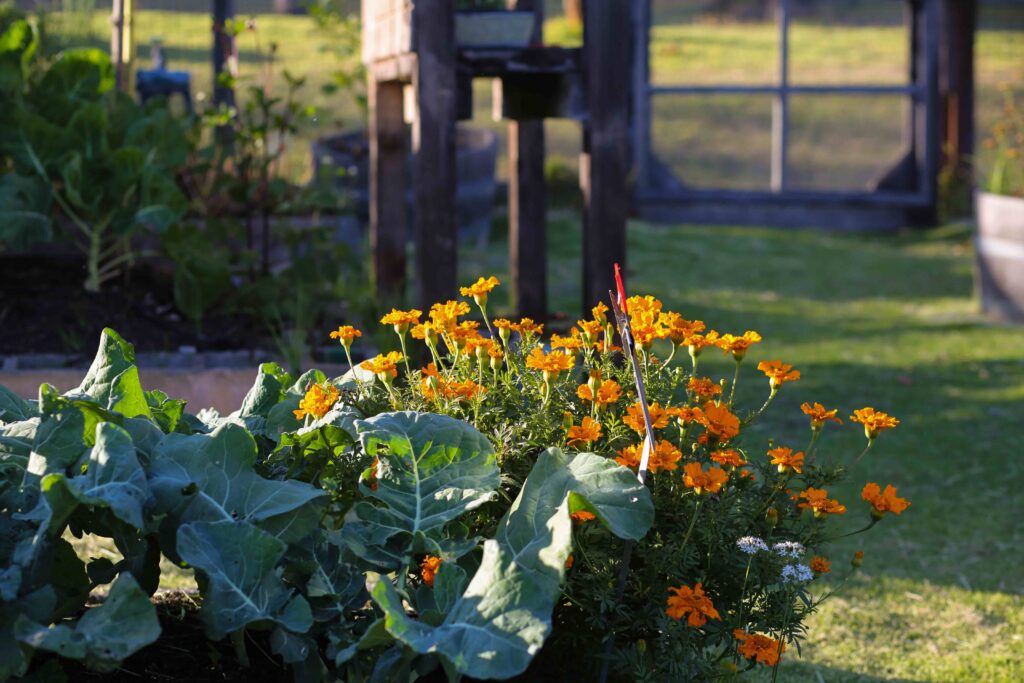
As the flowers begin to emerge each spring, the bees do too. When we see that familiar buzzing flurry, we know there is far more happening than meets the eye. While the bees gather nectar and pollen to sustain their colony, they are also helping our food grow. Without pollination, many fruits and vegetables would not produce, and so the bees play an essential role in keeping our gardens bountiful. In turn, those gardens nourish us and our guests.
Healthy bees contribute to healthy gardens and a thriving ecosystem across the property. It is a reciprocal relationship — we support the bees, and they support the land that sustains us all.
From Hive to Honey
Bees make honey as their primary food source, especially for the winter months when temperatures are too cold for them to forage and flowers are no longer in bloom. Throughout spring and summer, when nectar is abundant, they work to build up their stores. Whether and when we harvest depends entirely on the strength of the hive and the amount of surplus it produces. We take a cautious approach — we would always rather the bees have more than not enough.
When a hive has produced a true surplus, harvesting becomes one of the most rewarding parts of the process. We use a manual extractor borrowed from a fellow beekeeper. After gently uncapping the honeycomb cells, we place the frames inside and hand-spin the extractor. Watching the honey stream into a waiting bucket feels like magic every time.
The honey then rests for a few days before being poured into jars. We do not heat or heavily filter it. It remains raw and unaltered, preserving its natural enzymes and antioxidants. If our honey appears slightly cloudy, that simply means pollen and beneficial compounds are still present — exactly as they should be.
Because our bees forage across the property — visiting fruit trees, native shrubs, perennials, and annual flowers — the honey reflects the land itself. Ours tends to be light amber, sweet, and softly floral. It is always a joy to exchange jars with other beekeepers and taste how each landscape expresses itself differently.

Living With the Seasons
As we watch the rhythm of the bees’ life cycle and observe how closely they move with the seasons, we’re reminded that they are not so different from the trees and plants around them. There is a time for gathering and growth, a time for abundance, and a time to draw inward and rest. The bees, like the orchard and the gardens, teach us resilience, steady work, and the importance of slowing down when the season calls for it. These are lessons we carry with us as we continue tending the land and stewarding this property — hoping we never stop learning, adjusting, and growing alongside it.
When you visit in spring, we invite you to take a little time to notice the bees as Mar Vista begins to stir again. You may see us introducing a new colony to their hive, or quietly checking frames to be sure all is well. Or perhaps you’ll simply spot a honeybee moving from bloom to bloom in one of the gardens. Look closely and you might see the small “panniers of gold” gathered on her hind legs as she carries pollen home. No matter how many times we’ve witnessed that small detail, our eyes still light up. It is a simple, steady kind of wonder — a reminder that each season begins quietly, with small acts of work and care, and unfolds from there.
Love + Light Deanna + Cab